The argan tree is a small, gnarled, thorny thing that grows in one stretch of southwestern Morocco and almost nowhere else on Earth. The Souss Valley, running roughly from Agadir inland to Taroudant, sits at the centre of the argan belt. Drive any rural road here and you will see goats in the trees — actual goats, ten metres up, eating the fruit. They are not staged for tourists. They live up there.
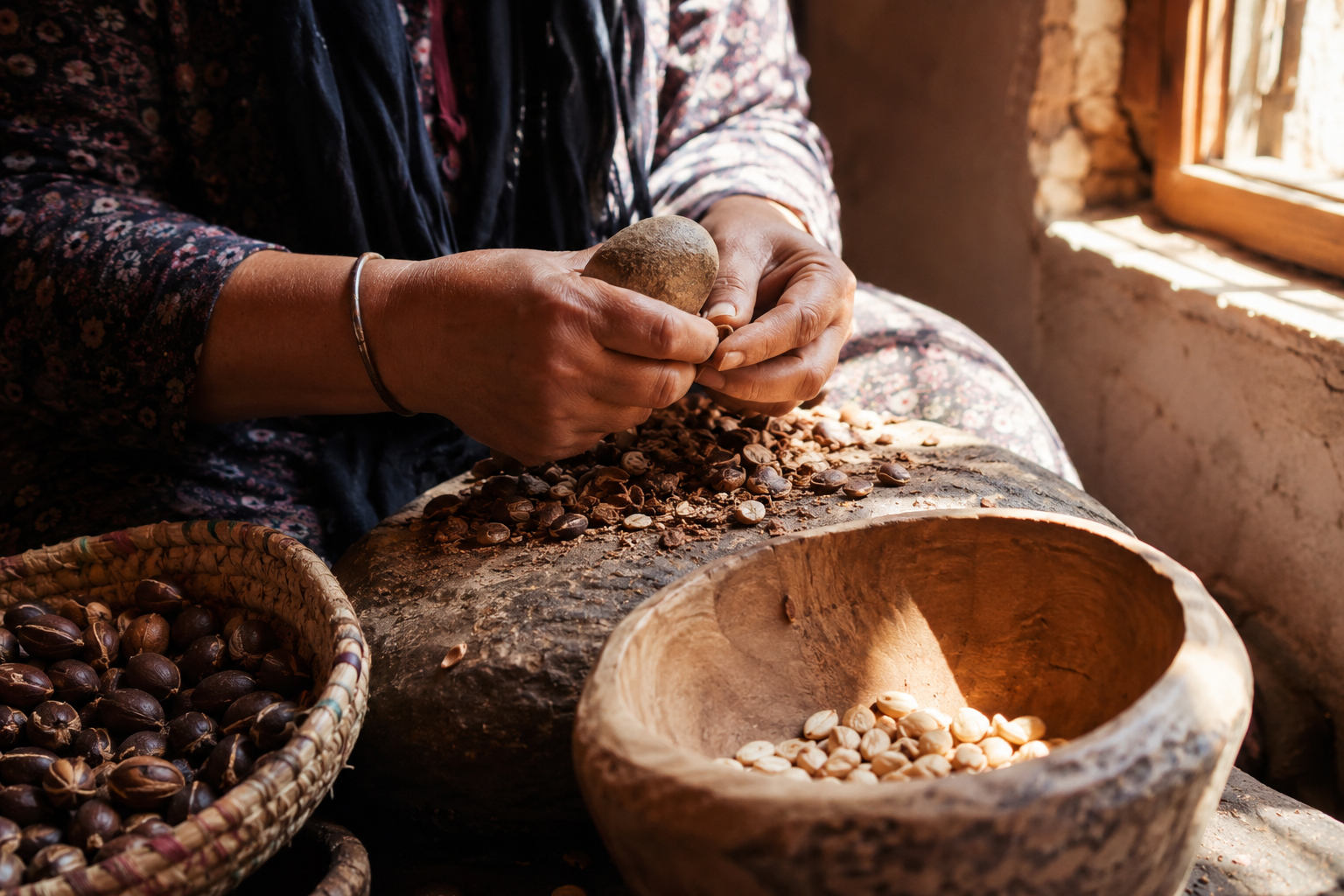
What comes out of the argan fruit, after the goats have done their part or not, is a small nut. Inside the nut is a kernel. Roasted, ground, and pressed, the kernel produces argan oil — culinary and cosmetic — which over the last two decades has become one of Morocco's better-known export products. The oil is genuinely remarkable. The economics around it are more complicated.
The co-operative model
Since the 1990s a network of women's co-operatives has emerged across the Souss to produce argan oil in a more regulated, fairer-paying way than the older household production. Most of the work — cracking the nuts, sorting the kernels, pressing the oil — is done by women. The co-operative model was meant to ensure they were paid for it.
Some of the co-operatives genuinely deliver that. The best are member-owned, run their own pressing facilities, and pay a steady weekly wage rather than piece rates. The women who work there can take literacy classes, send children to school, and have a degree of economic independence that was almost unheard of in rural Souss thirty years ago.
The other kind of co-operative
The label has also been gamed. A number of operations that call themselves co-operatives are essentially shopfronts for a single owner, who pays workers piece rates, takes the margin, and structures the business mainly to satisfy tourist coach parties looking for the "authentic" demonstration.
You can usually tell the difference within ten minutes. A real co-operative will show you the press, the storage drums, the certifications, and the books if you ask. A staged one will show you three women cracking nuts on a stone in the front room and steer you straight into the shop. Both will sell you oil. Only one will be paying the women fairly.
What to do as a visitor
If you want to buy argan oil, do not buy it on the coast in Agadir. Drive inland. Tioute, Taroudant, the villages around Ait Baha — these are where the real production happens. Ask, politely, to see the press. Ask to see where the oil is stored. Ask who owns the building. A genuine co-operative will be proud to answer.
The price will be higher than at the tourist stops. That is appropriate. A litre of culinary argan oil takes around thirty kilograms of fruit and several days of labour by skilled hands. Anything sold to you for ten euros is either adulterated, underpaid, or both.
The Souss Valley is not a glamorous part of the Moroccan tourist map. It is dry, hot, and agricultural. But it contains one of the more interesting recent stories in Moroccan rural economics, and you can see it happening in real time if you are willing to drive a little way off the main road and ask the right questions.