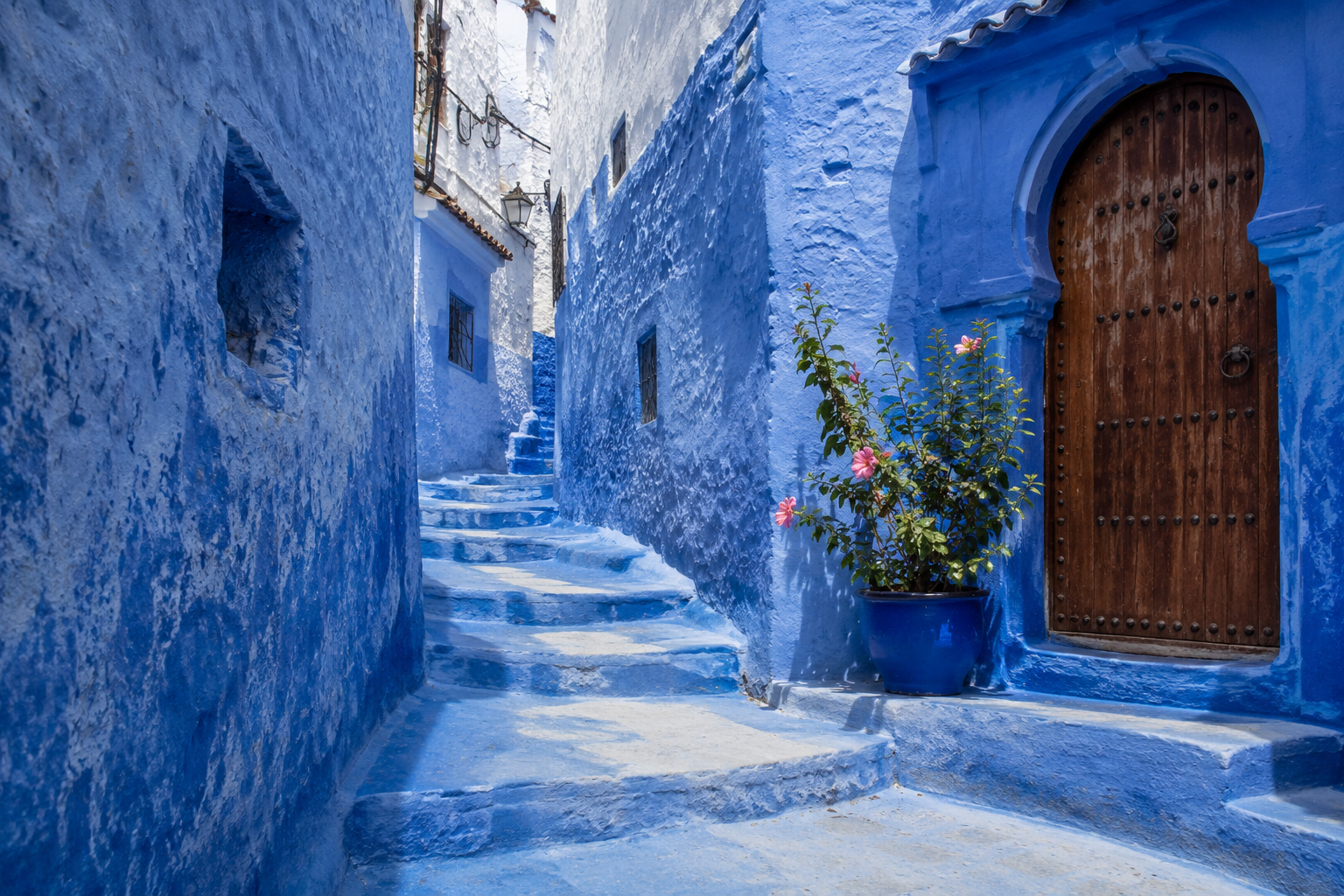
By now everybody has seen the photograph. The blue alley, the wooden door, the pot of pink geraniums sitting on the step, the staircase climbing out of frame to the right. There are probably twenty thousand iterations of this image on the internet. They are all of Chefchaouen, the small mountain town in the Rif, and they are all, broadly speaking, the same image.
The photograph is not lying. The streets really are blue. The doors really are pink and yellow. The geraniums really do sit on the steps. What the photograph misses is the rest of Chefchaouen, which is a working market town in the mountains that has been there for five hundred years and was not built to be photographed at all.
Why blue
The blue paint is the part everybody asks about first. The honest answer is that nobody agrees. One version says it was the Jewish refugees in the 1930s who introduced the practice, blue being a sacred colour. Another version says it deters mosquitoes. A third says it just looks nice and is cheap to mix from lime. All three are probably partially right. The town's residents repaint twice a year. The pigment comes from a couple of suppliers in Tetouan.
What is more interesting is that the blue is not uniform. Look closely. There are at least eight blues, from a chalky milk-blue to a deep cobalt. Each household chooses its own and re-mixes its own. The visual harmony is not centrally planned. It is the cumulative effect of every family on every street making the same kind of decision over and over for several generations.
The Saturday market
If you can be in Chefchaouen on a Monday or Thursday, do. Those are the souk days, and the upper town fills with farmers from the Rif who have come down with sheep, olives, cheese, walnuts, herbs. The Rif is one of the more agriculturally distinctive regions of Morocco and the produce is unusual — soft mountain cheeses you do not find in Marrakech, very small dark olives, fresh herbs nobody in your home country has heard of.
This is the Chefchaouen the Instagram tourists miss entirely, because the souk is two streets up from the blue alleys and looks completely different. The shop fronts are not painted. The animals are real. The currency is small denomination cash and a lot of bargaining in Rifian Berber. Stand in the middle and listen for ten minutes. The language is not Arabic. It is not quite anything else either.
What to do with the afternoons
Walk up. There is a trail above the town leading to the Spanish mosque, a small ruin on the hillside built in the 1920s and never really used. The walk takes about forty minutes and the view at the top is the entire valley with the town in miniature below. Most evenings there are a few groups up there sharing food, sometimes a guitar. The cafe culture in town runs late into the night around the central Plaza Uta el-Hammam.
Chefchaouen rewards two nights. One night is just enough to see the photograph from the inside. Two nights gives you the souk, the hillside, the cafes after dark, and the slightly disoriented feeling of having spent a day inside a colour. That feeling is the real attraction, and no photograph really conveys it. You have to go.