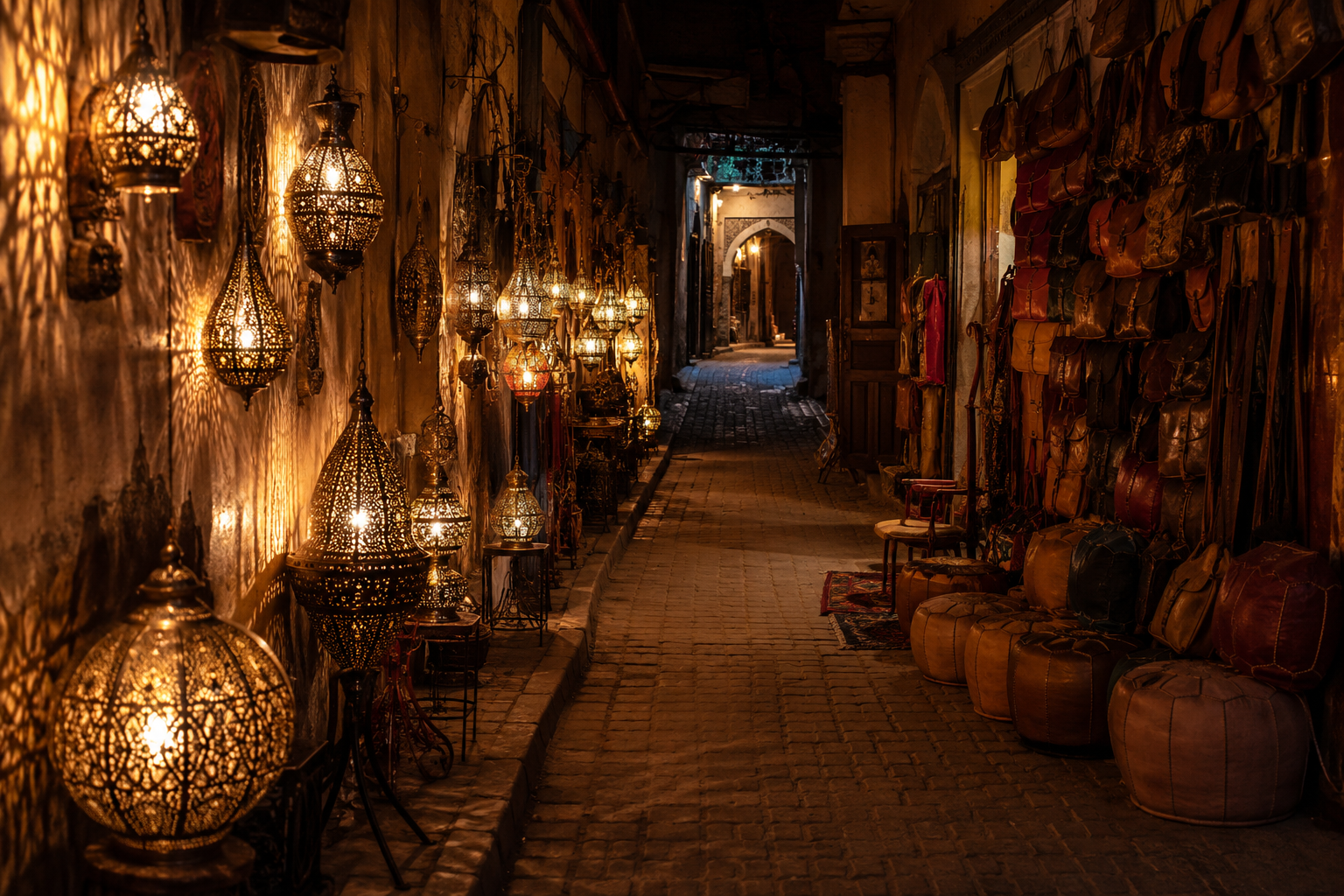
The first time I walked the Marrakech souk at night I was looking for an alley I had visited that afternoon and could not find it. The souk re-arranges itself after dark. The shutters that were closed are open. The shutters that were open are closed. The cats redistribute themselves. The route you took at three in the afternoon, with two hundred other tourists, has become a different city by nine.
This guide assumes you have already done the daytime version. You have squinted at carpets, you have been hustled in fluent French, you have eaten a tagine. Good. Now wait for the call to evening prayer and start again.
Starting point: Jemaa el-Fnaa
Begin in the main square as the food stalls are being assembled. This part of the evening is well-documented and worth seeing once, but it is not where we are heading. Walk north along Rue Souk Semmarine for a few minutes, past the brass lanterns and the leather, and then take the first proper left into a quieter lane. You are now in the operational souk, where Marrakech actually buys things.
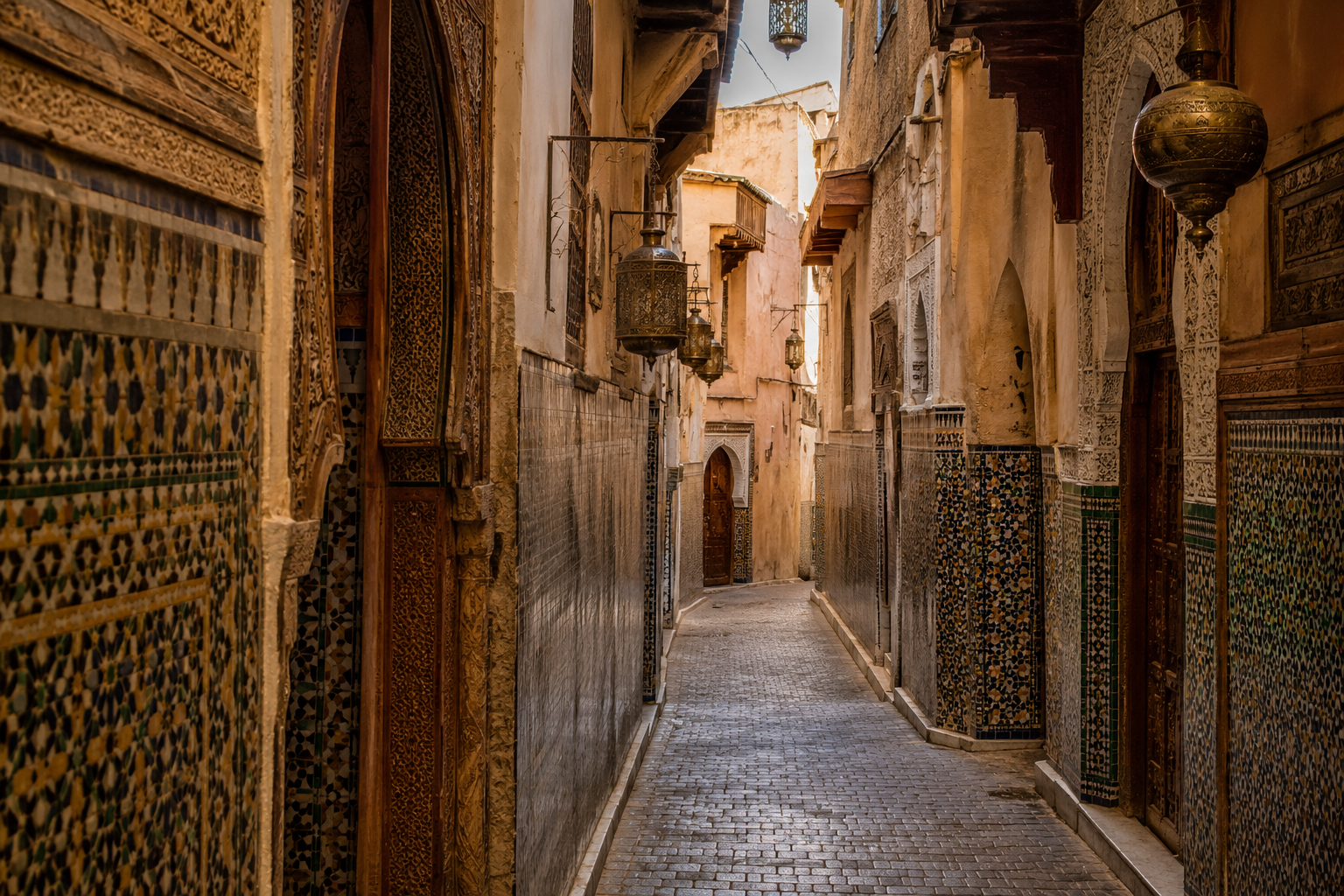
By ten o'clock most of the tourist stalls have closed. What remains open tends to be useful: ironmongers, plastic-bucket sellers, a tailor still hemming trousers under a single bulb. The light is yellow, the sound is muffled, and the smell shifts every fifteen metres — leather, then mint, then frying oil, then nothing at all.
The dyers' quarter and the metalworkers
Aim for the dyers' souk, Souk des Teinturiers. By daylight it is dramatic and photographed to death. After dark the hanging skeins have come down and the workshops are mostly shut, which is exactly the point. You can see the architecture properly. Stand under the wooden roof beams and look up. There are eight centuries of soot on them.
From here, drift roughly east toward the metalworkers. The hammering thins out at night but does not stop, and the open furnaces look medieval, because they are. Nobody will try to sell you anything. You are clearly not in the market for a copper pot at this hour.
Coming back out
To get back to Jemaa el-Fnaa, use the simple Marrakech medina trick: when in doubt, follow the cats. They know the routes that have a kitchen at the end of them. Within ten minutes you will hear the square again — the drummers, the snake charmers packing up, the smoke from the food stalls.
The night souk is not a hidden Marrakech. There is no such thing. It is the same Marrakech, on a different shift. The traders living above their shops, the families eating couscous on stools in a back lane, the kid running an errand barefoot at half past ten — that is the medina behaving normally. The daytime version, the one with the coach parties, is the unusual one. Walk at night and you remember which is which.