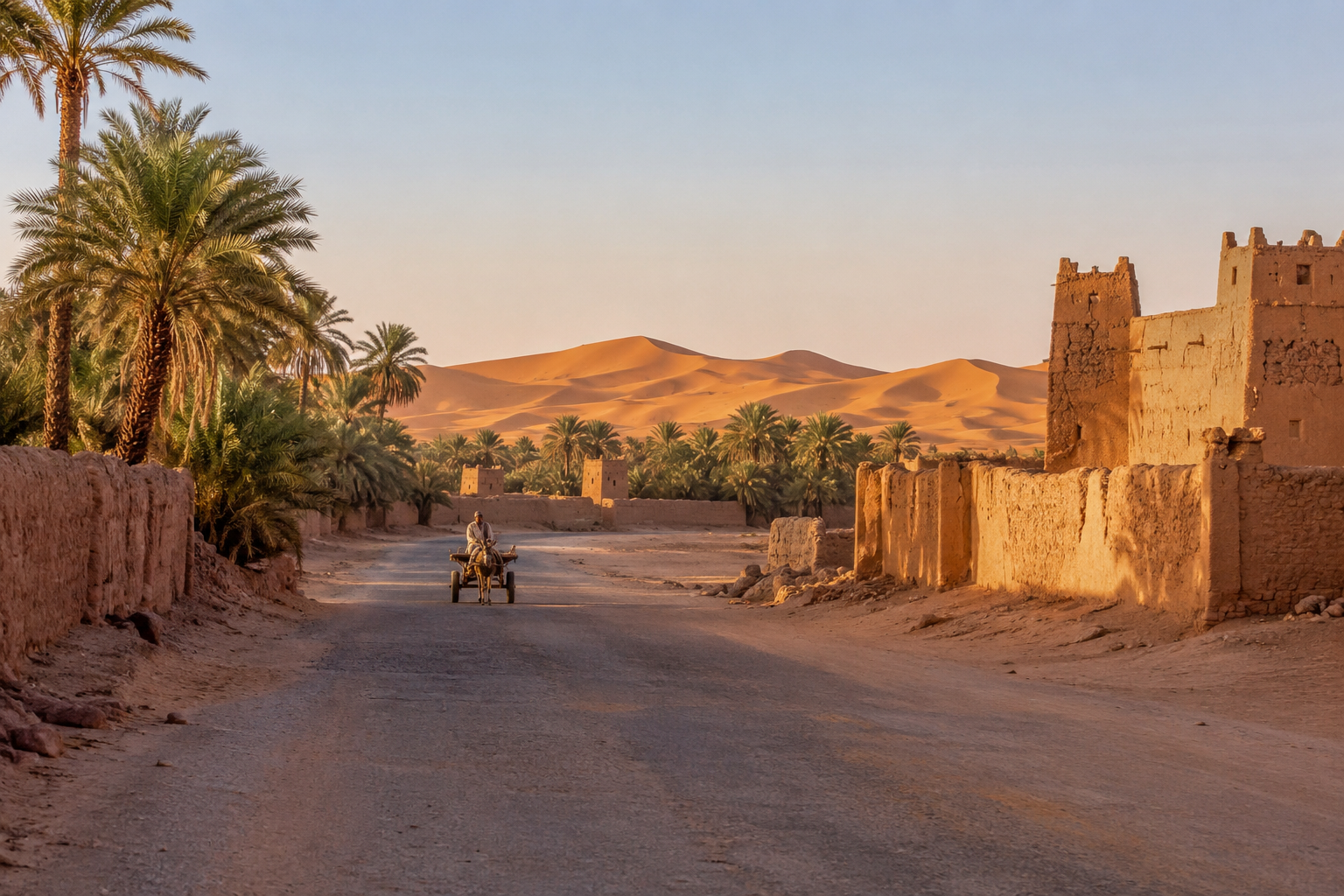
South of Zagora the road number does not really change but the road itself starts to give up. The tarmac thins. The shoulders crumble. The palm groves on either side, irrigated by the Draa river, grow patchier and patchier until you realise you are no longer in a palm grove at all. You are in scrub. And then, eventually, you are in something that is not even scrub. You are in Mhamid.
Mhamid el-Ghizlane is the small town where Moroccan tarmac runs out. There are roughly eight thousand residents, a few cafes, a handful of guesthouses, and beyond the last building the sand begins. Stand on the southern edge of town and there is nothing between you and Mauritania except about a thousand kilometres of the Sahara desert, which is a fact that takes a few minutes to sit with.
Why come here instead of Merzouga
Most desert visitors in Morocco end up at Merzouga and Erg Chebbi, which is the larger, more dramatic dune field to the east. It is the right choice for a first-time visitor. Merzouga is well-organised, the dunes are spectacular, and the infrastructure is reliable. But Merzouga is also where everybody goes.
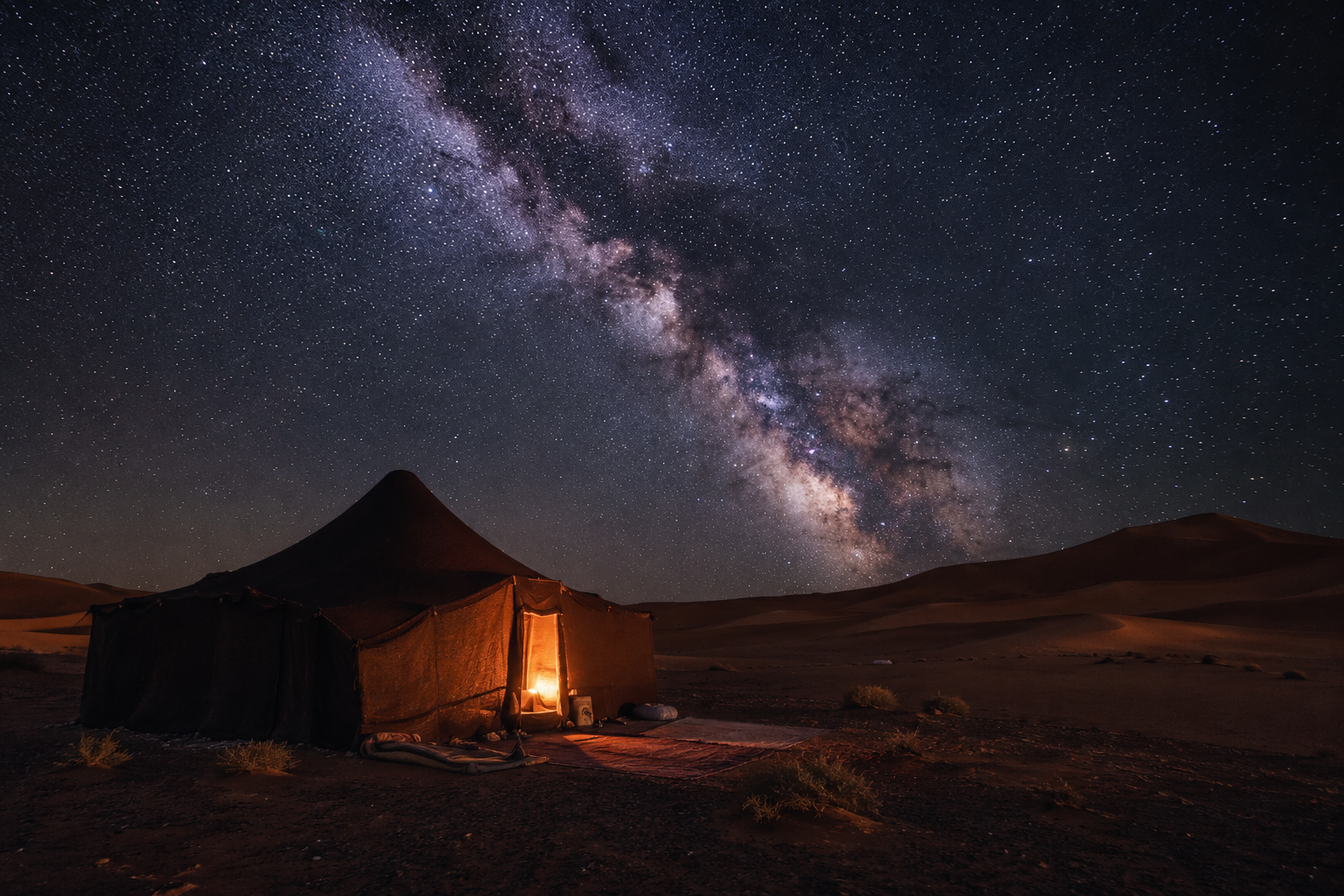
Mhamid is the alternative for travellers who have done Merzouga once already, or who simply want fewer other camels in the photograph. The dunes here, in Erg Chigaga, are a serious 4x4 ride away from town — about two hours over open desert — and almost nobody bothers. You arrive at a smaller, quieter, more genuinely isolated camp. The trade-off is the journey. The reward is that nobody else has bothered making it.
The town itself
Mhamid is not pretty. That is part of its honesty. It is a frontier town in the old sense — the kind of place where supplies come in by truck once a week and the diesel station is the most important building. The houses are low and earth-coloured. The cafes are small. The wifi works most of the time, the electricity most of the time.
What it does have is people. The town's population is a mix of Berber, Arab, and Sahrawi families, and the Sahrawi presence in particular is something you do not really feel in the rest of Morocco. The music is different. The clothes are different. The pace of speech is slower. You are, in a way Marrakech can never quite manage, in the cultural antechamber of the Sahara proper.
The annual festival
If you can be in Mhamid in March, the Taragalte festival is worth the journey by itself. It is a small annual gathering of nomadic and Sahrawi musicians from across the western Sahara, held in a desert site outside town, and it remains the kind of festival that has not been ruined by external sponsorship. The crowd is mostly local, the musicians are extraordinary, the camp is run on its own terms.
Mhamid is not a comfortable destination. The drive from Marrakech is long, the food is repetitive, the wind in March will sandblast your face. But it is the closest most travellers will get to the actual Sahara — not the postcard, the desert. You drive south until the road quits, and then you are there. That is rarer than it sounds.